



Hospitals may need to transfer patients across state lines to receive specialized care. This process may involve setbacks and complications if not handled correctly. According to Harvard Medical School, interhospital transfers can be fraught with risk.
From incomplete medical records to insurance complications and physician handoff gaps, the coordination required to move a patient safely between hospitals in different states is complex. The Centers for Medicare & Medicaid Services defines care coordination as ensuring healthcare is “patient- and family-centered” with needs and preferences “known and communicated.” The good news? Understanding the challenges and following a structured framework can enable your family member to receive seamless care.
The Core Challenges of Coordinating Care Across State Lines
Interstate medical transfer involves far more than arranging transportation. A 2024 BMJ study found that significant obstacles can arise during hospital-to-hospital coordination, including incomplete or inaccurate information, uncertainty about care responsibilities and differing expectations among care teams and patients. Recognizing these challenges opens the door to addressing them effectively.
Medical Record and Information-Sharing
Achieving complete and accurate medical record transfer is one of the most persistent barriers in cross-state patient transport. Electronic medical record systems vary widely between facilities, and interoperability remains inconsistent. According to a 2023 study, effective care coordination depends heavily on interoperable health IT, and poor information exchange is a primary barrier to seamless transitions.
Information gaps between care teams can lead to treatment delays, medication errors or duplicated testing. Doctors at the receiving facility need comprehensive records to continue uninterrupted care. Health providers must rely on manual processes to close communications gaps that could otherwise introduce risk and inefficiency. The solution is to partner with an experienced medical transport team.
Insurance and State-Line Complexities
Planning a hospital transfer involves paying careful attention to financial and regulatory details. Asking incisive questions up front prevents surprises later.
Financial concerns add another layer of difficulty to multihospital transport. Insurance coverage can become complicated when crossing state lines, as provider networks and coverage policies vary by state. What’s covered in one state may not be in another, leaving patients and families uncertain about costs.
Different states also have varying regulations that affect care delivery and reimbursement. To protect your finances, contact your insurance provider before the transfer to verify network status at the destination facility and understand out-of-network implications.
Ensuring Clinical Continuity and Physician Handoffs
The handoff between sending and receiving physicians is an inflection point that can compromise patient safety. A standardized report prevents interruptions in care, including medication reconciliation, which involves verifying an accurate list of medications to continue or adjust.
The SBAR method — situation, background, assessment and recommendation — is a widely recognized framework for communicating critical information during transitions. When doctors use standardized approaches, patients benefit from consistent care that accounts for their complete medical history and current needs. Choosing a transport provider that coordinates directly with both medical teams makes these handoffs reliable and thorough.
Legal and Regulatory Hurdles
Beyond clinical and financial challenges, legal complexities can affect interstate transfers. State-specific laws govern everything from physician licensing to data privacy requirements. HIPAA provides federal baseline protections, but some states impose additional restrictions on how organizations can share electronic health records.
Complicating benchmarking and care uniformity, hospitals in different states must also report on disparate patient metrics. These regulatory distinctions require a careful, measured approach to maintain compliance while keeping patient welfare at the forefront. A knowledgeable transport provider will take some of the stress off your shoulders by expertly guiding you through these complexities.
Your Framework for a Successful Interstate Hospital Transfer
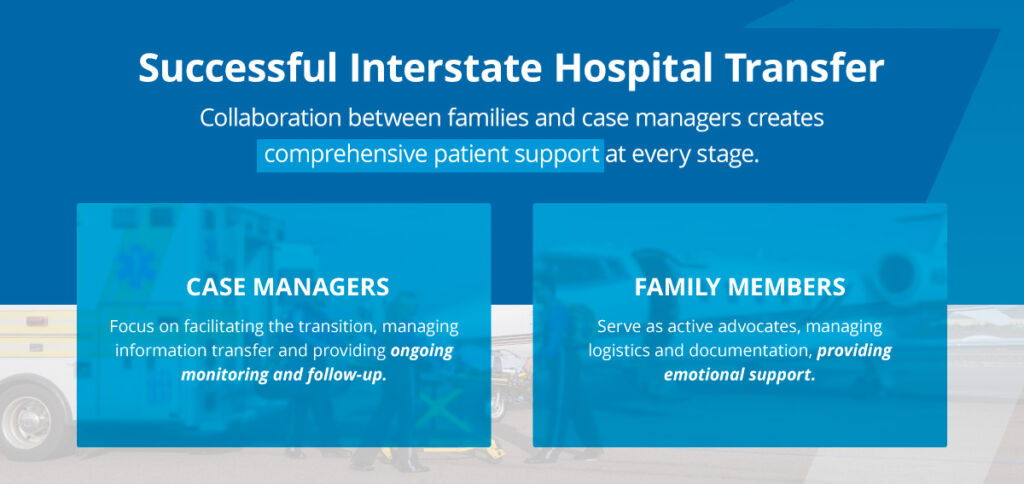
Collaboration between families and case managers creates comprehensive patient support at every stage. Follow this structure to coordinate effectively and achieve the best possible outcomes.
Case managers focus on facilitating the transition, managing information transfer and providing ongoing monitoring and follow-up. Their expertise maintains clinical continuity and regulatory compliance.
Family members serve as active advocates, managing logistics and documentation, providing emotional support and continuity and using technology for remote consultation when distance is a factor.
Pre-Transfer Questions to Ask and Documents to Gather
Preparation is critical to successful coordination. Complete this checklist to ensure nothing falls through the cracks.
- Essential documents: Gather current medical records, insurance cards, advance directives, power of attorney documentation and a complete medication list before the transfer begins.
- Information from the current hospital: Confirm the patient’s current diagnosis, treatment plan, pending test results, discharge summary and contact information for the attending physician.
- Questions for the receiving hospital: Ask about their admission process, whether they have bed availability, what specialized equipment or services they offer and who the attending physician will be upon arrival.
- Insurance verification: Contact your insurance provider to confirm coverage at the destination facility, understand pre-authorization requirements, clarify covered transportation costs and identify out-of-network considerations.
- Transport provider questions: Inquire about the medical crew’s qualifications, what medical equipment will be available during transport, how they will communicate with you along the way and what the total cost includes.
Choosing a Medical Transport Partner for a Seamless Transfer
A professional medical transport partner is a critical link in the care coordination chain, bridging gaps between facilities and maintaining clinical continuity. They remove barriers to care, improve patient access and outcomes and take the logistical burden off your shoulders so you can focus on your loved one.
Not all air ambulance providers offer the same level of care or coordination. Evaluating potential partners requires attention to multiple qualifications.
- Accreditations: Seek providers with recognized accreditations that demonstrate adherence to rigorous safety and quality standards.
- Medical crew experience: The crew should include highly trained professionals with critical care expertise who can manage complex medical needs during flight.
- Quality aircraft: Fixed-wing aircraft designed for long-range transport should feature advanced medical equipment to maintain care standards at every stage.
- Proven safety record: A long safety history reflects a provider’s commitment to patient welfare and operational excellence.
- Transparent communication: The provider should offer clear, honest communication about costs, timelines and what to expect during the process.
The Importance of Bed-to-Bed Service and Holistic Care
Bed-to-bed service eliminates gaps in care by accompanying patients from the current facility to the receiving hospital, including ground transport on both ends. This comprehensive approach prevents handoff errors and maintains clinical oversight from departure to arrival, giving you peace of mind that your family member is never without expert medical supervision.
Holistic care goes beyond medical monitoring to address patients’ emotional and comfort needs. Services like noise-canceling headphones, aromatherapy and personalized attention can reduce stress and ease healing.
Get Started With AirCARE1
AirCARE1 understands the complexities of coordinating care across hospitals located in different states. Our team specializes in long-range, fixed-wing medical transports that provide bed-to-bed service, ensuring continuity throughout. Let us handle the logistics, work with your medical team and provide holistic care that supports your loved one’s physical and emotional needs.
With transparent pricing, experienced medical crews and a commitment to doing what’s right for every patient, we’re here to make the process as smooth as possible. Request a quote today.